


Let me say this upfront, because I know how these posts can read: I am not here to drag America. I lived there for most of my life. I love a lot of it. I have people there I would do anything for.
But I've been living in rural France for a couple of years now, with two children in the French school system and a husband who spent seventeen years teaching in Southern California. And the comparison that's been persistently forming in my head is worth writing down.
So that's what this is. A comparison. From the inside, from both sides, with as much honesty as I can manage.
Also: I am aware that neither Los Angeles nor rural France is representative of their entire countries. I’m a writer, not a researcher. And this is a personal essay. Not a policy paper.
With that established, here’s what we’ve noticed.
The tree incident.
Before we moved to France, our son was attending a preschool in Los Angeles. Not an expensive one by LA standards - about $1,000 a month for two to three half days a week (which tells you everything you need to know about LA standards).
It was a co-op model, meaning parents volunteered regularly in the classroom. Progressive approach: gentle parenting, child-led discovery, project-based play, no formal academics. Just playing, mostly outside. We actually liked it quite a bit.
Then there was the tree incident.
I was sitting at a little table outside with some children, art supplies scattered around. The kids were drawing. I picked up a crayon and drew a tree. A simple tree. Not a masterpiece. Just, a tree.
About thirty minutes later, one of the teachers held up my drawing and said, loudly: “Whose drawing is this?”
The other parent volunteer shook his head. I slowly raised my hand.
She walked over and explained that parents are asked not to make exceptional drawings in the classroom, as it discourages children.
“It makes them feel inferior,” she said.
“Oh,” I said.
I want to be very clear: it was not an exceptional drawing. It was a tree drawn by someone who is not an artist, using a child’s crayon, in approximately ninety seconds.
This scene frequently pops up in my memories - partly because it was genuinely absurd. Partly because I understood, somewhere in the moment, that we had crossed a line I hadn’t known was there before - from thoughtful progressive education into something that had been pulled a bit further west than I was comfortable with. The instinct was right. The execution had gone somewhere strange.
What my husband saw in the classroom.
Sean taught in Southern California public schools for seventeen years, across different ages and districts. What he watched happen over that time was a slow, significant shift in the balance of authority between teachers and students.
It didn’t happen all at once. It happened through a series of lawsuits, policy changes, and cultural shifts that, taken individually, each made a certain kind of sense. Taken together, they produced classrooms where teachers had almost no practical authority and students knew it.
The paperwork required to formally report a student’s behavior became so extensive - unpaid hours outside the classroom, elaborate documentation, administrative processes that could take weeks - that most teachers simply stopped trying. Failing a student became nearly impossible. Not because students were passing, but because the administrative barriers were so high that districts found it easier to move students through than to hold them back. This kept graduation rates looking good on paper. It kept lawsuits at bay. It did not keep students learning.
He watched reading levels drop. Spelling levels drop. Basic math skills erode. He watched it happen year after year and felt increasingly powerless to address it.
We had friends visit us here in France - both still teaching in Southern California. They sat in our kitchen, exhausted, and told stories that would make your hair stand up. Teachers being reported to administration by parents for the crime of setting boundaries. Teachers facing termination threats for ‘disciplining’ (basically saying: “Please don’t do that thing again”) students who were genuinely disrupting other children’s ability to learn. A system so thoroughly inverted that the adults had less authority than the children they were supposed to be educating.
I am not saying French schools are perfect. I am saying it is not like that here.
On bubbles.
Here’s something I didn’t expect: moving to France showed me how thoroughly I had been living in a parenting bubble, among other bubbles.
Shortly after we arrived, we were having dinner with some friends who live in London - two parents, two kids, shared interests. I referenced a parenting book I’d read, the way you reference something everyone knows. They’d never heard of it. I was genuinely shocked. This book had been discussed by every parent I knew in Los Angeles. It had felt universal.
They mentioned a book that was popular in their circle. I’d never heard of it either.
It was a small moment that landed heavily. I had spent years absorbing a very specific parenting philosophy, in a very specific city, surrounded by people reading the same books and listening to the same podcasts and using the same language, and I had mistaken that bubble for the whole world.
The book they mentioned was The Danish Way of Parenting by Jessica Joelle Alexander and Iben Sandahl. I bought it immediately, as my first attempt to puncture the bubble. It was most excellent. Highly recommend.
The authority question, and the sixteen-year-old.
French teachers have authority. And I want to be clear about what I mean by that, because authority has become a loaded word lately, conjuring images of power without accountability, of rules without reason.
I don’t mean authoritarian. I mean authoritative. There’s a meaningful difference. Authoritarian is power for its own sake. Authoritative is the earned, calm, consistent presence that children actually need from adults - the kind where children listen not because they're afraid of consequences but because the adult in the room has established, through consistency and genuine care, that they are worth listening to. That’s what I’ve observed here. That’s what I mean.
This was a genuine culture shock for us at first. The communication style is more direct than we were used to - less cushioning, less hedging, less of the elaborate softening that Americans tend to wrap around anything that might be even slightly uncomfortable to hear. Teachers here say what they mean. Parents are told what they need to know. Nobody seems to find this rude. It just seems to be how adults talk to each other when they respect each other's time.
I wonder whether this has something to do with what we’ve observed in French teenagers generally. Because the teenagers here are different. Not all of them, not universally, not as a law of nature - but as a general pattern, what I’ve seen is young people who are comfortable around adults in a way that I suppose stopped feeling normal to me somewhere along the way in America.
We were invited to a neighbor’s house for a goûter shortly after we arrived - one of those gatherings where you’re welcomed into someone’s home and introduced to a room full of people who have all come specifically to meet you, which is its own whole thing and I’ve written about it elsewhere. Midway through the afternoon, the family’s sixteen-year-old grandson walked in.
He gave a cheerful bonjour to the entire room of adults. Then he bent down and gave each of my children - whom he had never met in his life - a kiss on the cheek.
I almost cried.
Not because it was sentimental, though it was. Because I couldn’t remember the last time I’d seen a teenage boy walk into a room full of adults and be genuinely, uncomplicatedly present. No sulking. No performance of disinterest. No phone-as-shield. Just a kid who said hello to the adults and was kind to the small children and then sat down and participated in the conversation like a person.
What teenage boy, in my experience of American teenage boys, would consider that cool?
We’ve heard versions of this story from other expats, too. A British couple we know here had their teenage daughter’s French friends over one afternoon. They told us about it afterward with the slightly dazed energy of people describing something they’d witnessed but couldn’t fully explain.
The friends arrived and stood at the entryway. One by one, each of them said bonjour to both parents before walking into the house. Not a mumbled acknowledgment. An actual greeting, to each adult, individually, before entering. Like it was simply the cost of entry (because apparently here, it is).
Throughout the visit: please and thank you for everything. No entitlement about snacks or drinks. Offers to help. Zero expectation of being served. The parents kept looking at each other. They said they almost didn’t know how to act.
And that’s the ‘cool question.’ In America, we have spent decades organizing adolescent culture around the idea that coolness - which is essentially peer approval, which is essentially the opinion of other fourteen-year-olds - is the currency that matters. We have built schools and social structures and parenting philosophies around accommodating that currency rather than questioning it.
There’s a book called Bringing Up Bébé by Pamela Druckerman - an American journalist who had children in Paris and spent years trying to figure out why French children behaved so differently from American ones. One of the things she found: French children are expected, from a young age, to say hello to adults they know. Not as a performance of politeness but as a genuine acknowledgment that other people exist and have their own feelings and needs. The idea being that children are not the center of the universe, that they have the ability to give as well as receive, and that learning to be present with adults is part of what growing up means.
It’s a rule so ingrained it becomes invisible. The teenagers at the door weren’t being exceptionally polite. They were just doing what French children do. The sixteen-year-old at the goûter wasn’t remarkable by local standards. He was just a normally raised French boy.
And that was perhaps the most surprising part. Not necessarily that it happened, but that it was considered normal.
We see this playing out in the most literal way imaginable at school pickup time for my pre-school-aged children. The teacher stands at the door as parents arrive, releasing the children one by one. Before a child is let go, they have to give a proper goodbye - au revoir, à demain, bon weekend, whatever is appropriate. The teacher holds onto them gently, just for a moment, until the child says it. Not aggressively. Not as punishment. Just as a simple, non-negotiable expectation: you say goodbye before you leave. Every day. To your teacher.
It takes about four seconds per child. It also teaches something that four seconds of anything rarely manages to teach: that the people around you deserve to be acknowledged when you leave them.
Multiply that by every school day, every year, from the age of three.
It’s a combination of things, probably - the schools, the family structure, the culture around mealtimes and conversation, the fact that adults here are still treated as adults worth knowing. But somewhere in that combination is a preschool teacher holding a child’s hand for four seconds, every single day, until it stops being a lesson and becomes just how you move through the world.
What I can tell you is what I saw in that room: a sixteen-year-old who walked in and made two small American children feel seen and welcomed, and walked out without making a big deal of it.
And a British couple, slightly knocked sideways in their own kitchen, watching a group of teenagers say please and thank you for everything and offer to help with the washing up.
If you’re new here: Once Upon a Castle is where I write about all of this. The château, the life, the cultural observations, and the ongoing education of two Americans in rural France. What you’re reading is free. Paid subscribers get Castle Diaries, where I document the renovation in real time. We’d love to have you along.
The lunch situation.
If you’ve seen Michael Moore’s film Where to Invade Next, you may remember the sequence where he visits a French school cafeteria and watches children eat a four course lunch on real plates with real silverware. Then he shows them photographs of American school lunches. The children stare at the photos with the polite confusion of people being shown evidence of something they cannot explain.
The four course lunch is real. I can vouch for it. My children eat it every day.
My husband, as a teacher in California, ate lunch in about twelve minutes at his desk while grading papers. In France, the school lunch is long. An hour and a half, sometimes approaching two hours. The children eat a starter, a main course, a cheese course (because France considers cheese a non-negotiable component of a child’s lunch, which I have decided is correct), and a dessert. Many of the ingredients are organic and local. It says so on the weekly menu, which parents can view online.
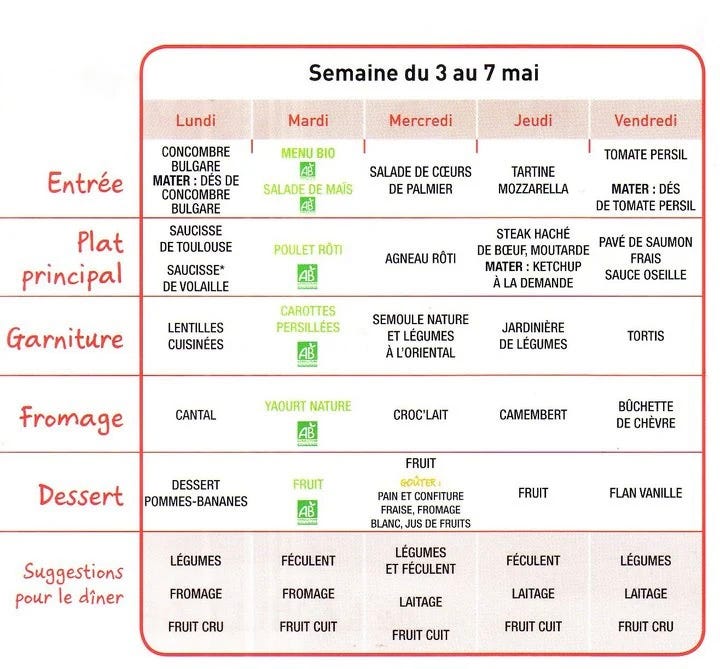
This is not a fancy private school in Paris. This is a small rural French school in a town most maps don’t bother to label.
My husband used to tell parents in Los Angeles: if you want your child eating well, pack their lunch. School lunch is not an option.
Here in France, packing their lunch is not an option either, but for the opposite reason. In two years I have never once seen a parent send their child in with a packed lunch. It would be, frankly, weird. The only exception is field trips. The school lunch here isn't something you opt out of. It's just what lunch is. And it’s amazing.
The calendar.
Many French schools have no school on Wednesdays - ours included. It's not a universal rule across France (some schools run five days, others just have Wednesday afternoons free), but it's common enough that the four day week has come to feel completely normal to us. A mid-week break that lets everyone reset, lets teachers recover, and means children come back on Thursday actually ready to be taught rather than running on fumes.
Every six weeks, there are two weeks off - staggered by region across France so that not everyone is fighting for the same hotel rooms in the same week. We’ve loved these breaks. The regularity of rest built into the school year rather than tacked on at the end of it.
The school day starts at 8:45am and ends at 4:30pm, which is longer than most California schools but starts later, and that later start, it turns out, makes a meaningful difference in how rested everyone arrives.
And summers. Long, generous summers. School ends in late June or early July and starts back up in September. The full summer, properly observed.
I am aware this sounds like I’m describing a utopia. I want to be clear that there are still trade-offs. The school hours are slightly longer, on average The homework load, from what I’ve heard, gets significant as kids get older, which is similar to the U.S. The academic approach is traditional - teacher at the front, students in rows, considerable amounts of memorization. Child-led discovery is not the dominant pedagogy here. We’ll see how all of this looks as our children get older and I’ll report back as we go.
The college question.
I’m going to mention this briefly because it’s relevant to the broader picture, even though our kids are years away from it.
In the US, students at public in-state universities pay an average of $11,610 per year in tuition and fees, with out-of-state students paying $30,780. When you factor in housing, food, books, and other expenses, in-state students paid an average of $29,910 per year and out-of-state students paid $49,080. Private universities run considerably higher - with some approaching $100,000 for a single year of attendance.1
In France, tuition for EU citizens at public universities is approximately €175 EUR per year - roughly $182 USD. For non-EU citizens, tuition at the bachelor’s level runs around €2,850 per year, approximately $2,966.2
When I tell our French friends what college costs in America, they practically spit out their wine.
France can still revere education - can still treat a degree as something worth having and worth respecting - partly because a degree here doesn’t require twenty years of debt repayment to justify. The investment is real but proportional. The return is plausible. You can get a good education, not destroy your financial life in the process, and then go do the thing the education prepared you for. This is apparently a radical idea.
My husband and I both have master’s degrees. We value education. It’s genuinely nice to live somewhere that agrees with us about that, and also makes it structurally possible.
What I’d take from each.
I think about the U.S. preschool sometimes, including the parts that worked. The outdoor time. The play-based approach for young children. The gentleness. Those things were genuinely good and I’m glad our son had them.
I think the answer, as it usually is, lives somewhere in the middle. Children need play and discovery and the dignity of being trusted to figure things out. They also need adults who are respected and classrooms where learning is actually possible. These things are not mutually exclusive. Getting the balance right is the hard part, and I don’t think either country has fully cracked it.
What France seems to have done, at least in the small rural school where my children spend their days, is treat certain things as non-negotiable that have become negotiable elsewhere: food, rest, the authority and respect of teachers, the rhythm of the school year, the idea that lunch is not an obstacle between two periods of productivity but an actual event worth having properly. I'm not saying American schools don't care about these things. I'm saying that caring about them and being structurally set up to deliver them are two different things. And the structure here is different.
My kids are happy here. They’re learning. They’re eating cheese.
For now, that feels like enough.
Five things worth borrowing from the French school model, wherever you are:
Since I believe in being useful and you’ve read this far, here are things that require no visa application:
Protect the lunch. Even at home, even on weekends - make lunch an actual meal at an actual table. Not at the desk. Not in the car. Not optimized. Just lunch, eaten slowly, with other people if possible. The French are onto something here and it costs almost nothing to try it.
Build in the Wednesday. You probably can’t give your child Wednesdays off school, but you can build a mid-week reset into your family rhythm. A slower evening. A no after-school activities afternoon. Something that interrupts the forward momentum and lets everyone breathe before the second half of the week.
Take the holiday seriously. France builds rest into the calendar structurally. Most of us don’t have that luxury. But we can choose to treat the holidays we do have as actual rest rather than logistical challenges to manage efficiently. Two weeks where you genuinely stop is worth considerably more than two weeks where you work from the beach.
Reconsider the school lunch. If you’re packing your child’s lunch, make it real food. Maybe try adding in a different cheese each week. Not as performance or Instagram content, but because what children eat in the middle of the day affects how they feel and learn in the afternoon. The French approach this with the seriousness it deserves.
Let adults be adults. This one is harder and more contested and I offer it gently: there is something worth examining in a culture that has so thoroughly shifted authority away from teachers and toward students and parents that teachers can no longer do their jobs. Supporting teachers - actually supporting them, not just saying so - might be one of the more useful things any of us can do.
Once Upon a Castle is where I write about this life - the château, the renovation, the cultural observations, and everything France keeps teaching me that I didn’t know I needed to learn. Paid subscribers get Castle Diaries, where I document the renovation in real time. Come stay a while.
À bientôt,
Kamille
If you’re new, start here:

Bankrate - “Average Cost of College 2024-2025” URL: https://www.bankrate.com/loans/student-loans/average-cost-of-college/ Published: July 28, 2025 Source data from: College Board.
educationdata.org - “Cost of College by Country [2025]: Average Tuition Fees” URL: https://educationdata.org/average-cost-of-college-by-country Published: January 21, 2025.
I loved this! I live in Northern California with 2 teenagers in the public school system. For lunch because there is no cafeteria to fit in all the students, they go across the street to Safeway, buy some crap and sit outside Safeway in hoards, even when it is pouring with rain. My son will often take his own lunch because we aren’t forking over money every day like a lot of the kids.
And then the phones, always on their phones at lunch. This is a huge issue as you all know. They are talking about implementing the pouches where each kid has to put their phone in a pouch which is locked by a teacher and unlocked at the end of the day. You will faint when I tell you the cost of implementing this…$200,000!!!!! An insane amount of money when programs are being cut from the budget and teachers are losing their jobs. And it won’t work since the kids find ways around it like putting a ‘burner phone’ in the pouch or using a magnet to open it. I don’t understand why the school can’t just say “no phones during school. If we see it we will take and then call your parents to come and pick it up.” Easy free solution!!! But no, they can’t because they are terrified of parents reaction, the outrage that their spoilt, entitled children can’t use Apple Pay to pay for their $20 pizza at lunch and they want to be able to get a hold of them throughout the day.
Oh I could go on and on. There is zero respect for teachers, the students run the asylum and it isn’t working. There is no accountability or recourse for bad behavior and everyone suffers. The teachers are burnt out and frustrated and have stopped caring and teaching. The kids don’t have boundaries and are always nervous to ask for help because the teachers don’t have the mental capacity to help.
My mother was French, went to school in Paris with a very similar schedule to your kids. I went to school in boarding school in the UK which is a whole other story but it worked. The teachers were thoughtful and were respected and there were consequences for rudeness, not getting homework finished, etc…we all knew where we stood, the balance was clear and we had to learn to problem solve by ourselves! Clearly I have thoughts….thanks for sharing your perspective, it’s important for people to understand that other countries have different values and processes around education which are much healthier for the schools and families. Oh and don’t get me started on guns…😞
Sorry, didn’t mean to write a whole post here. It touched a nerve in a good way and is probably something I need to write myself….although if any of the locals read it I may be run out of town as disloyal! 💜🇫🇷
Kamille, this piece speaks volumes. I understand so, so much about what you’re revealing. I have felt utter dismay for several decades here, watching the dumbing down of American education. I have been equally grateful I have gotten my three degrees back when I was younger, and that I am 73 now and don’t have to grow up in these times in the US, and that I am not responsible to raise children here. What keeps coming to mind is an admonishment I read recently: Don’t prepare the road for your children; prepare your children for the road. We are failing in this country. France is succeeding, beautifully. Quelle incroyable!