


Three years into France, and three months into château life, I’ve learned something that still short-circuits my American brain: appointments here are not negotiated.
There’s no “what works for you?” No choreographed back-and-forth where both parties pretend to have equally complex schedules and eventually land on something neither of them wanted in the first place. You get a time and a date, delivered with the laid-back authority of someone announcing the weather.
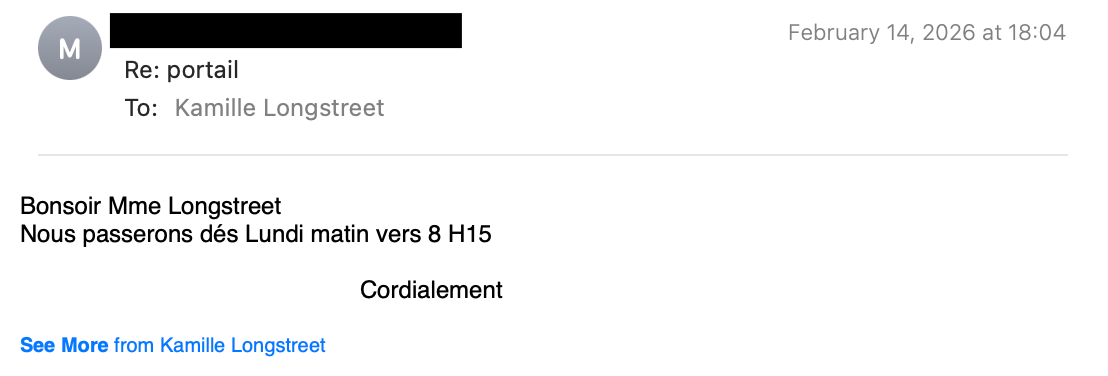
Bonjour,
Your appointment is Monday at 8h15.
Cordially,
French Person
RECEIPT:
You can try to move it, of course. But you’re basically asking for a big fat (French) favor.
If you're new here, I'm an American writer living in a small château in rural France with my husband and two children. Once Upon a Castle is where I write about the château, the renovation, and the ongoing education of two Americans in rural France who thought they knew what they were getting into. What you're reading is free. Paid subscribers get four additional posts each month - two more essays about French culture and life from the inside, and two chateau renovation diary entries documenting the detailed renovation, in real time. Come stay a while.
The email that contains your fate
The first few times this happened, I assumed I’d missed a polite French nuance. Surely “Your appointment is Thursday” meant “Would Thursday work for you?”
It did not.
“Your appointment is Thursday” means: your appointment is Thursday. If you can’t make it, you may attempt to renegotiate, but you should understand you’ve stepped into a universe where access is a privilege and the calendar belongs to the person behind the desk.
It took me longer than I’d like to admit to stop reading this as rude and start reading it as something else entirely.
Why this is (a little bit) logical.
There’s a logic to it once you stop fighting it.
Work flexibility is baked into the culture here in a way it simply isn’t in America. A doctor’s appointment isn’t treated like an extravagant lifestyle choice requiring advance apology. You say, “I have an appointment” and the response is essentially: yes, of course, that’s life. Nobody asks you to schedule around your lunch break or find a time that doesn’t inconvenience anyone. You have an appointment. You go.
There’s also a different assumption about what counts as considerate. In America we think we’re being thoughtful by asking for availability - by opening up the calendar and letting the other person choose. Here, the thoughtfulness runs the other direction. I have solved the scheduling problem. Here is your slot. You’re welcome. The ten-email chain to find the perfect overlap of two calendars is not, here, considered a good use of anyone’s time. People would rather eat lunch.
The nerve.
When access is genuinely scarce (and in rural France, certain specialists and tradespeople are genuinely scarce), you take the slot you’re given, you show up, and you don’t perform pickiness you can’t afford.
The ‘we’re coming tomorrow’ people.
Then there’s the second phenomenon, which is adjacent but considerably more chaotic.
This one happens with tradespeople, particularly the ones you’ve been chasing for weeks. You email politely. You call, you text. You wait. You begin to wonder if you’ve been blocked for being the annoying American squeaky wheel. You make peace with the silence. You move on emotionally.
Then suddenly, out of the bleu:
Bonjour, nous venons demain. (Hello, we are coming tomorrow.)
No “does that work?” no preamble, no explanation of where they’ve been. Chasing them does nothing. What works, apparently, is giving up - at which point they sense the shift in energy and appear.
I spent a long time finding this infuriating. Now I see it as a variation on the same theme. The assigned appointment and the sudden "we're coming tomorrow" are cousins. Both are saying: here is when this is happening. Before, they weren’t confirming because they didn’t have availability. Now they do. And if you say "actually tomorrow doesn't work," you lose the slot, you lose the momentum, and you lose them - back into the silence from which they briefly, mysteriously emerged. So you clear your calendar and you say d’accord and you stop asking questions.
Our first exposure to all of this.
Our first real encounter with this energy happened before we’d even fully arrived.
We’d just flown in from Los Angeles with everything we owned, hauling a small mountain of luggage through the airport. We were waiting at oversized baggage for our two car seats. One came through. The other didn’t. We filed a claim at the counter. “When we find it, we will call you,” they said.
We went home, and waited. Three days passed without a word. On the fourth day I called them, sat on hold until I had mentally redecorated our entire kitchen, and eventually reached someone who confirmed: not found yet, sorry, we'll be in touch.
I hung up, dejected.
Less than an hour later, while we were having lunch in the garden, a van pulled up the drive. A man climbed out holding our missing car seat like he was delivering a prophecy. No warning. No tracking notification. No “would this afternoon work?” Just: here it is.
I stood in the garden blinking in the sunlight and said merci approximately eight times. Maybe more.
(merci. merci! MERCI. mer-ci. …merci. mErCi? merciiiiii.)
That was my first clue. Silence in France usually means something is still in motion somewhere. Then it shows up solved.
My inner project manager meets France.
In America, scheduling has taken on a vaguely moral dimension. Being organized means planning ahead. Caring means confirming. Professionalism means the rapid response and the Calendly link and the calendar invite with the Zoom link already embedded. The administration of things has become, somewhere along the way, the thing itself.
Here, the performance is optional. What matters is whether the thing actually gets done, and whether everyone gets to eat lunch and keep their weekend intact.
I’m not trying to romanticize chaos. It is a genuinely different operating system, with different assumptions baked in about what time is for and what counts as respect. It gets considerably easier to accept when you’re three glasses into a long lunch and nobody is doing that thing where they pretend to listen while secretly replying to an email under the table.
What we’re actually doing differently now.
A few things we’ve learned, for anyone navigating this:
If you get a slot, take it. Assume it’s the good one. Don’t hold out for something that fits better - in rural France, the next available might be months away and it will also arrive without warning.
Leave buffer in your calendar. If you stack your days like dominoes, France will knock them all over. Nothing important gets scheduled after a “we’re coming tomorrow” text.
Brace for the clumps. Nothing for weeks, then everyone appears on the same Tuesday. There’s no system for predicting it and no point pretending otherwise.
Keep your humor close. Not because everything is funny, but because it’s the cheapest coping mechanism available and it travels well.
The weird upside
What I didn’t expect was how much being assigned appointments would start to do something to me. Over time, being taken out of the negotiation has started to take me out of the performance of it, too. The constant managing of everyone’s time, the confirming and re-confirming, the anxiety of the unanswered message - a lot of that has simply stopped being part of my day. And I didn’t realize how much energy it had been taking until it wasn’t there anymore.
I still like knowing what day something is happening. I still like clarity. I’m not fully French and I’m not pretending otherwise.
But I am learning.
Even if the learning is happening, as most things here do, without my consent.
If you've lived somewhere that runs on this kind of scheduling logic - France or otherwise - drop it in the comments. The more unhinged the better.
À bientôt,
Kamille
Once Upon a Castle is where I write about this life - the château, the renovation, and what it actually looks like to trade everything familiar for something completely unknown. Free subscribers get two posts a month. Paid subscribers get six - two more essays like this one, two renovation diary entries from inside the walls, and access to everything in the archive.
It does bring me back to the book A Year in Provence by Peter Mayle!
So interesting. I feel like our culture rewards "the most options possible", when really, less can be more. Maybe there is freedom in not having to make quite as many decisions. I really enjoy your writing! Cheers!