


Almost everything written about moving to France is, essentially, an advertisement.
I know this because I’m one of those people who writes about it. I have personally published articles about bluebells and four-course school lunches and a man who refills your wine glass without you ever catching him doing it, and every one of those things was true, but there are other parts of living in France that aren’t always ‘on the brochure,’ so to speak.
I can see how an article on ‘11 people who shouldn’t move to France’ can come across as a warning, but this isn’t really one. If it were a warning, I’d have to explain what I’m still doing here, three years in, typing this from a small, 17th-century château with a chapel in the woods behind it. These are tradeoffs to be sure, and every one of them is a thing I either accepted, adjusted to, or am still occasionally (or not so occasionally) annoyed by. The question isn’t whether they’re real (oh, they’re real), but rather, whether they’re yours.
Most of those who already love France will likely read this and check every item off with a confident “That’s not me!” and feel tremendously reassured. That’s probably the most likely outcome, which is lovely. But perhaps a few of these will help tip the balance if you’re deciding between France and somewhere else, or help you avoid a real shock once you arrive, if you’ve already made up your mind.
If you’re new here, I’m Kamille. Three years ago we left California for rural France with two kids and considerably more optimism than French. We’re now restoring a small château, and Once Upon a Castle is where I write it down as it happens, including the parts that don’t make it onto the brochure. Come stay a while.
First, what’s not on the list
You don’t have to like wine. I barely drink. I have sat at long French tables for the past three years nursing the same glass like it’s a prop (which it mostly is), and nobody has ever made it weird. (There’s a whole etiquette about not pouring your own, which I found out the hard way, but that’s in a different post.) If you don’t drink at all, you will be handed sparkling water and an excellent piece of cheese and nobody will investigate.
You don’t have to be fluent. Our French is not fluent, and we’re still okay, and still here.
You don’t have to be rich. People assume a number. The number they assume is wrong in both directions. We're two musicians, and we bought a château. Draw your own conclusions.
You don't have to have French ancestry. Or an EU passport, or a grandmother from Lyon, or any prior connection to this country whatsoever. There's no heritage test. There's a visa, and there's an income question, and both of those are manageable.
So now, here’s the list.
1. You hate paperwork
Not “find paperwork annoying.” Everyone finds paperwork annoying. I mean you have an actual physiological response to administrative friction, the kind where a form with a broken upload field can take your whole afternoon and possibly your sanity with it.
Because here is the thing about French bureaucracy that took me two years to understand: it is not disorganized. It is extremely organized, in a system that was designed by people who are no longer alive, and which has been added to but never subtracted from. Every rule has a reason, and the reason is from 1953.
You will be asked to prove you exist, after which you will provide the proof of your existence, and you will then learn that the proof has an expiration date you did not know it had. You will then be asked for the same information three times by three offices that cannot see each other’s files, and all three will be mildly surprised you found this inconvenient.
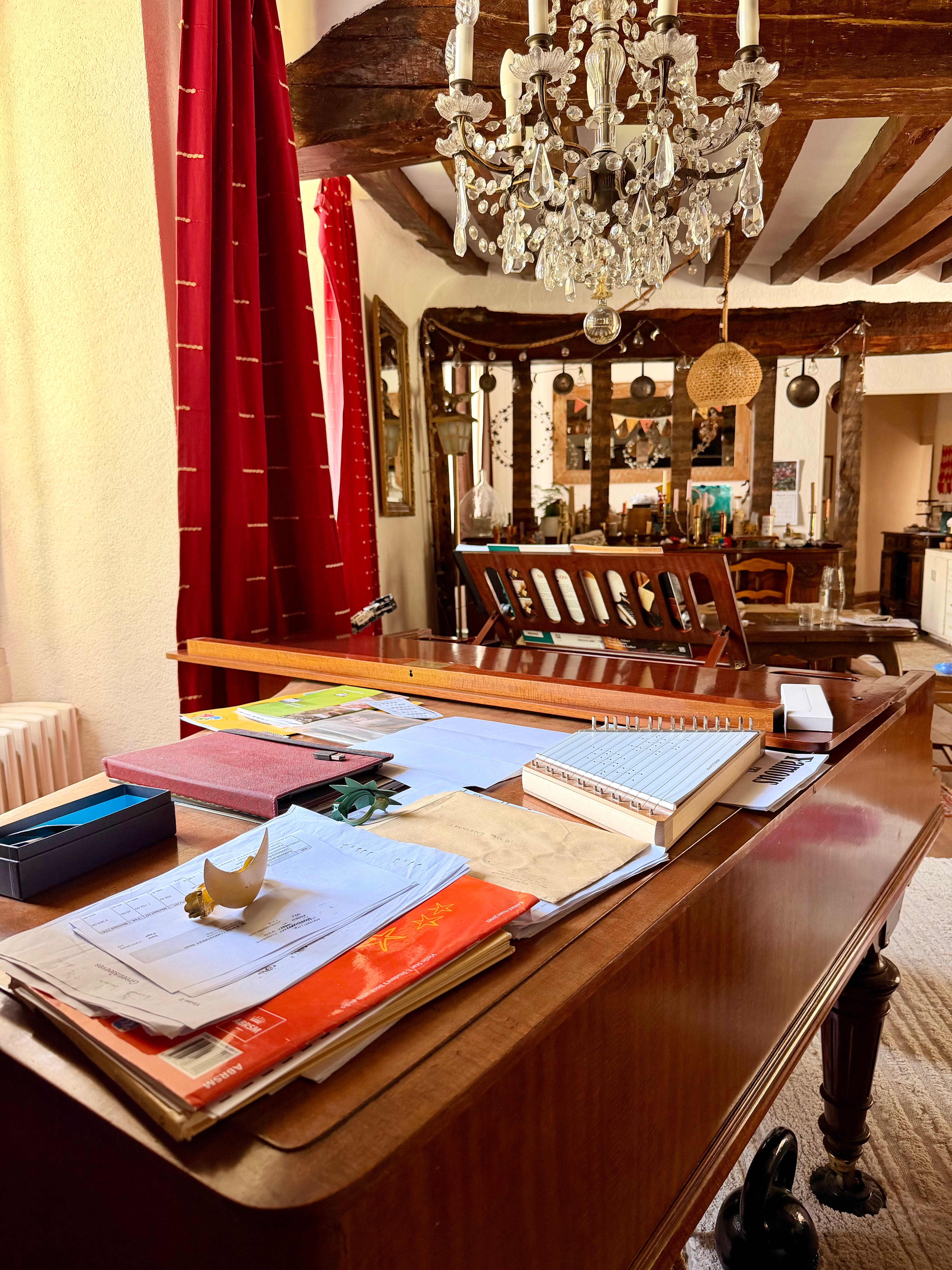
It is also getting more expensive and more demanding, not less. Validating a long-stay visa after you arrive now costs €300. It was €200 until May 1st, 2026.1 And as of January 2026, getting your first multi-year residence card now requires a certified A2 French level plus a passing grade on a new civic exam, which is 40 multiple-choice questions, 45 minutes long, and you need to get 32 of them right.2
I’m not saying this to scare you. Those are, after all, reasonable things for a country to ask. I’m saying it because there are quite possibly a lot of people planning around a version of France that stopped existing in January, and I’d rather you plan around this one.
If your reaction to that paragraph was “fine, I’ll make a folder,” you’re fine.
If your reaction was a small hot feeling behind your eyes, you should take that seriously. I’ve written about how this stuff rewires you, and it does (eventually).
2. You need things to happen when someone said they would happen
A date, here, is not a commitment. A date is a general indication of time.
You will be given a Tuesday. The Tuesday will pass. Several Tuesdays will pass. You will send a polite email, then a less polite email, then you will make peace with it and move on emotionally (or not), and that is the moment a van appears in your driveway with no warning whatsoever. The scheduling logic here has its own internal sense and I’ve come around(ish) to a lot of it.
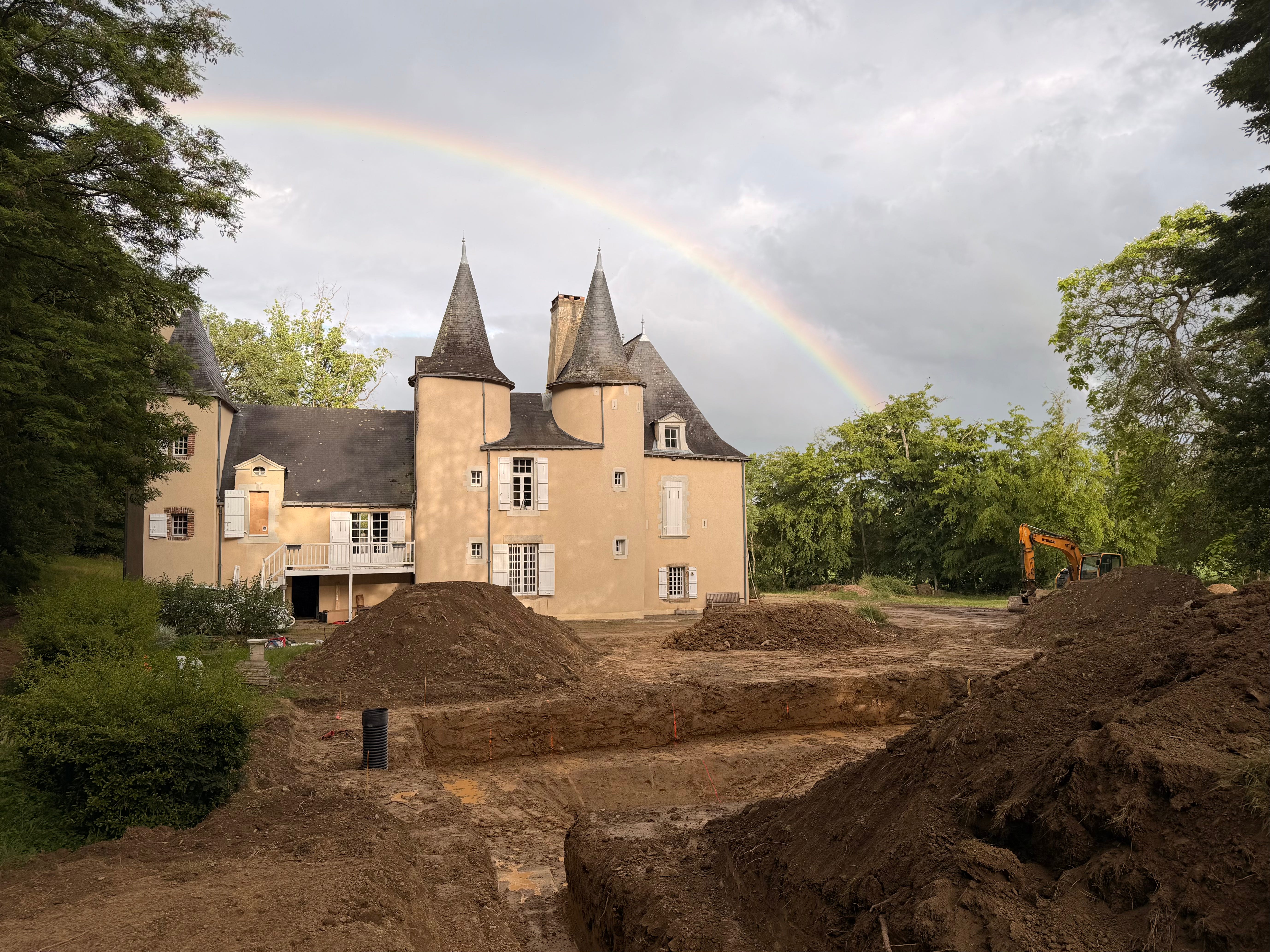
But I want to be honest about the cost, which is that you cannot run a tight operation on top of this. You cannot have a hard deadline that depends on another person showing up. If your work or your temperament requires other people’s reliability, you will spend a year in a low-grade rage and it will not make anyone come faster.
3. Your life is built on convenience
Let’s be specific, because “convenience” is quite vague.
In France, there is no Costco, no Target, no Amazon same-day delivery (at least not in the countryside). No Whole Foods where the thing you need is always in stock and there are 11 versions of it. No avocados in February that are ripe and good and ready for Taco Tuesday.
On Sundays, most things are closed. Some places close on Mondays too (just to keep you humble). Lunch closes the town for about two hours. In August, a meaningful percentage of the country is simply elsewhere.
And if a real part of your financial life runs through your airline miles card and the points ecosystem and the cashback stack, be aware that you are leaving the country that invented that game and entering one that doesn’t really play it. French bank cards are mostly debit, or débit différé, which charges everything to your account in one monthly batch and is the closest thing most people here have to a credit card. Rewards cards barely exist. Nobody is offering you 75,000 bonus points to open an account. Your US cards still work fine (just watch out for those foreign transaction fees!), but the everyday-spend earning you’ve carefully built a travel budget around mostly stops, so plan accordingly.
4. You’re vegan
It’s not that France can’t feed you. Bigger cities are just fine. There are far more vegan restaurants in Paris and Lyon and Nantes than there were five years ago, produce here is outstanding, and the markets will keep you extremely happy.
It’s more so the everyday texture that wears on people. Butter is in things. Just, magically injected into the fibers of the French food supply. Lardons are in things that have no business containing lardons. Cheese is an entire course here, and declining the course is declining a small social ritual that’s happening around you several times a week. Rural restaurant menus can sometimes have absolutely nothing for you (unless you try to be clever and order the croque monsieur without cheese, which is essentially just toast, but they’ll bring you the dang toast and it will have butter on it, and they’ll look shocked when you tell them that butter is also dairy and not something a vegan can eat). Dinner at a neighbor’s house becomes a logistics conversation every single time, and you will be the person having it, possibly forever.
And if you have vegan kids, look hard at the school canteen, because opting out isn’t really the culture. Lunch at school is a four-course sit-down meal and it’s one of the best things about French childhood. A child who can’t eat most of it is having a different experience of the day than the kid next to them.
None of that is a no. Vegans do live here and thrive. But it’s a daily tax rather than an occasional one, and you’d be wise to ‘price it in.’
5. You like large portions
The food is better, and there is also less of it.

You will either find this a relief or you will find yourself, at 4pm, standing in front of an open fridge that is full of excellent things, in a country that does not believe in snacking, wondering what happened to you (like me).
6. You can’t live with old things
Old houses are not neutral. They have sloping floors and doors that only shut if you lift them slightly at the same angle every time and light switches that do nothing, ever, and hazardous wobbly staircases. In February a stone house smells like a stone house. Most windows are single-pane and beautiful and they lose heat like an open mouth.
There’s a real personality split here that I don’t think people examine before they move. Some people look at an old surface or an old creaking door and see the life in it, the history behind it. Some people look at the same creaking door and feel a low, persistent itch to replace it. Neither one is wrong, but one of them is going to have a much better time in a country where “we repainted the shutters fifteen years ago” counts as recent.


If your baseline for a nice home is new, France is going to read as slightly run-down to you for at least a year. Some people’s eyes adjust, and some people’s never do.
7. You require central heating and air conditioning
This past summer was, according to Météo-France, the hottest the country has recorded since they started keeping track in 1900. Three and a half degrees above average, three separate heatwaves adding up to 53 days, and 104°F (40°C) was crossed 178 times (against 88 in the whole of 2003).
And the shops here just ran out of air conditioning units. Not just "hard to find." Sold out. And people became desperate. On the second of July, Lidl put fans and portable air conditioners on sale across the country, and hundreds of people lined up outside a store in Nanterre from before dawn. When the doors opened at 8am, the crowd forced them off their hinges and rushed the aisles to fight over the ten or so air conditioners actually in stock. Shoving, fists, police inside the store restoring order. The same thing happened at Lidls all over France that day. Grown humans. Literally fighting over air conditioning units. In France.
Even after all of that, only about a quarter of French homes have air conditioning.3 The demand is overwhelming and the installed base has barely moved, which means that if you’re picturing arriving in the countryside and buying a unit in July, you are picturing a queue.
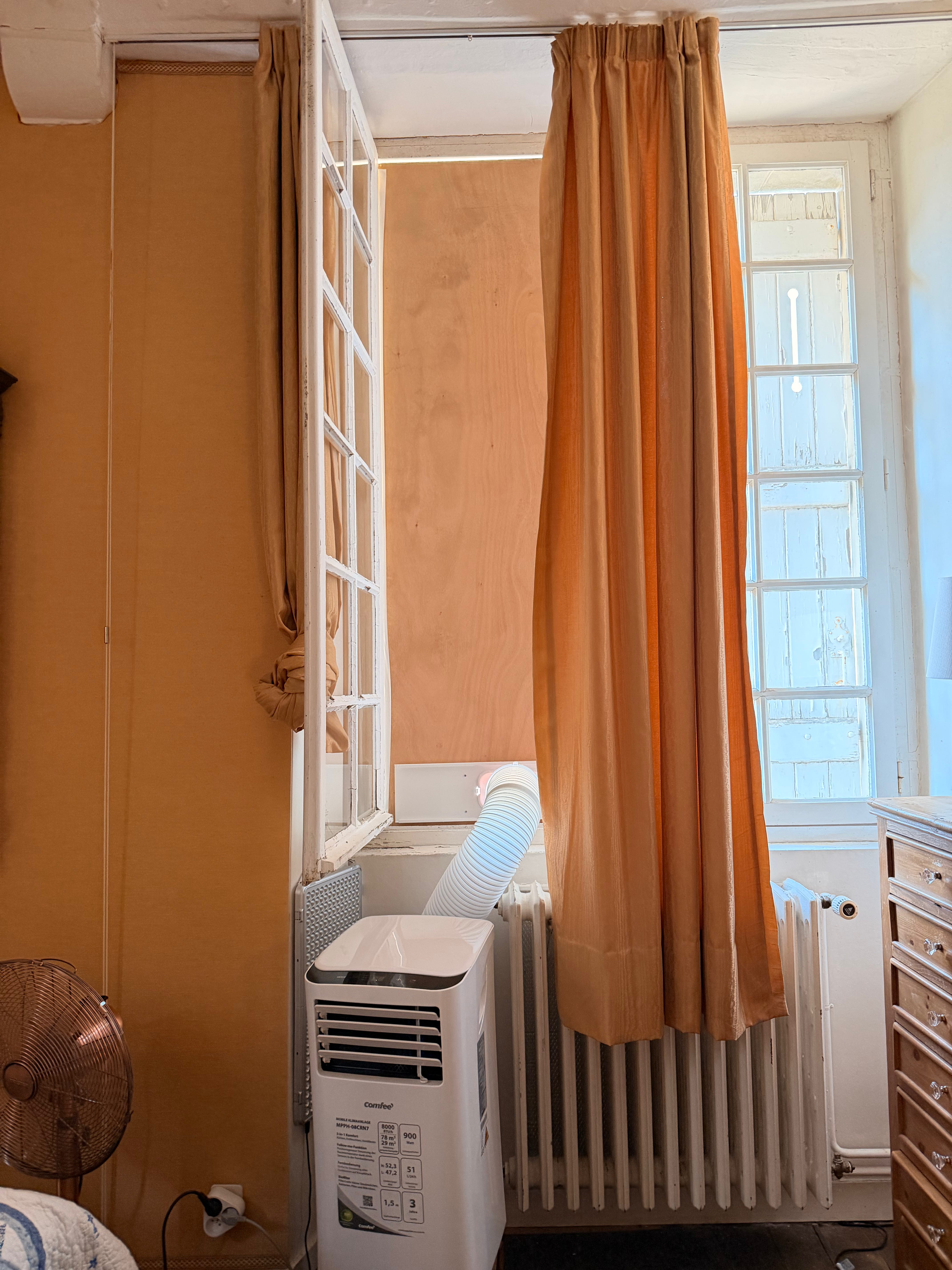
Heating is its own thing. Rural old houses usually do have heating, just not the kind Americans picture. Only about a third of rural communes are even on the gas network (against more than 90% of urban ones), so out here it’s wood and oil and heat pumps, and an old house with proper insulation and a modern system is a rare find rather than a default. Our own heater has been misbehaving since the day we moved in and the radiator knobs are broken, which means we can’t shut off rooms we don’t use, which means we are heating seven bedrooms for four people when we have it on. Highly inefficient, and a heavy weight on our fuel bill.
If you have a medical reason to need reliable climate control, this is not really a charm point. When you search for housing here, you’ll want to ask about the heating system before you fall in love with the spiral staircase.
8. Your driver’s license is from the wrong state
This one surprised me, so I want to give you fair warning.
A US license is good for one year after you become a resident here. After that you have to exchange it, and you can only exchange it if your state has a reciprocity agreement with France. Eighteen states currently do.4 Arkansas, Colorado, Connecticut, Delaware, Florida, Illinois, Iowa, Maryland, Massachusetts, Michigan, New Hampshire, Ohio, Oklahoma, Pennsylvania, South Carolina, Texas, Virginia, Wisconsin. The list gets reissued and it changes, so check the current one rather than trusting a blog (including this one).
If your state (like ours) isn’t on it, there’s no workaround. You just have to go through the French license process from the beginning. The theory exam, which is a truly difficult test that French teenagers fail all the time, then the practical exam, through a driving school. The average cost is about €1,800 nationally, more in Paris. Yeah, not cheap.
Three left, and they’re the ones that might actually decide it.
If you want more like this, free subscribers get two essays a month about what living here is really like, written from inside it.
9. You need to be good at things in public
For at least a year after you move here, you will be a slightly stupid version of yourself. Not actually stupid, but you’ll just have no way to demonstrate otherwise. You’ll be the adult at the table whose contribution to a fast, funny conversation is a delayed nod. You’ll be the parent who didn’t understand the school email and finds out on the day. You’ll hand over a sentence you rehearsed in the car and watch it land completely wrong because you pronounced an é as a regular e in one of the words and now they have no idea what you’re saying.
There’s a version of this that people underestimate because they’ve only ever experienced the vacation version, where being foreign is slightly charming and everyone finds your accent fun or delightful. But living here is different. The charm does have a shelf life (roughly the length of a holiday). After that you’re just a person who’s hard to talk to.
It goes in the same box as this: French people are warm, and they are not performatively warm. Nobody is going to over-function to make you feel comfortable. If your baseline sense of being okay in the world is topped up by several small pleasant interactions with strangers each day, that tap can get turned way down.
The people who do well here are the ones who can be bad at something in front of other people without it costing too much internally. People who can put themselves out there and also make the effort to make friends even when it’s not easy. You have to learn to be okay with making a fool of yourself over and over again. Not easy, but honestly a useful skill to develop. Start practicing now. Charades, in front of strangers, about a plumbing problem.
10. Your income doesn’t travel, and there’s no plan B
Here’s where I’m going to be blunt, because this is the one that actually ends the dream for most people and the internet is weirdly hushed about it.
The long-stay visitor visa, the one most Americans arrive on, requires you to sign a handwritten statement that you will not work in France. That’s not a formality. You also have to show/prove resources, currently a minimum of about €1,478 of income per month per person, and private health insurance.5
The good news (and this is genuinely new), is that in June 2026 the Interior Ministry answered a parliamentary question about remote work and said that a foreign national working from France for a company established abroad, paid and taxed abroad, doing nothing connected to France, should be considered non-active for the purposes of French law.6 That’s the clearest thing anyone in government has said on this in years, and it legitimizes a situation a great many people were already in and nervous about.
Though there are two honest caveats. A ministerial reply is an interpretation, not a law. And it’s written around a foreign employer, which is not obviously the same as freelancing for a scatter of US clients. (To any freelancers out there: get actual advice from an actual immigration lawyer rather than from a politically heated Facebook group or from me.)
If you need to earn money here, there are proper routes. The old “passeport talent” was restructured into the carte de séjour “talent” under the January 2024 immigration law, which suits high earners, founders, researchers and artists. There’s an entrepreneur and profession libérale route for freelancers, which requires a viable project and resources/income of around €1,867 a month. There’s also the standard salaried route if a French employer sponsors you.
But the underlying thing is simpler than any of that. If your career is location-locked to the United States, if it requires a US license or a US room or a US network that doesn’t work at a 6 or 9-hour time difference, and you don’t have another way to make money, then this is not really a visa problem, but an arithmetic problem, and moving will not solve it.
And I’d add a smaller, related one: if your goal is to make a boatload of money, France is a strange choice. Not impossible, but structurally not optimized for it, in a culture that doesn’t organize identity around work and taxes accordingly. If maximizing income is the point, there are better places, and I say that with affection for this one.
11. You’re moving to ‘fix everything’
If there’s a single sentence you’d finish with “and once we’re in France, everything will be better,” it’s worth looking at very hard.
Because while there are several significant quality-of-life items that improve upon arrival in France (pace, rest, food, work-life balance, affordability), there are other things that don’t improve, and those are the ones you’re bringing with you. Your problems are portable, and they travel extremely well, and they arrive fully unpacked before your shipping container does. A marriage that’s struggling does not get easier when you remove both people’s friends, language, and competence in the same month. It gets harder. Everything gets stress-tested, all at once, in the same season.
Moving abroad is an amplifier. If the underlying thing is good, it gets louder and even better. If it’s fragile, you will find out fast.
My advice is to make any major repairs before you get here, so you’re not relying on France to fix everything, and then feel ultimately let down when it doesn’t.
The reality
None of these are verdicts, and they don’t even weigh the same. Number five is kind of a joke, and number ten just is or isn’t.
You can be three of these things and be just fine, because the upside is truly high enough to absorb a lot of friction, as long as you know which friction you signed up for. I think what breaks people isn’t the tradeoff necessarily. It’s discovering the tradeoff in month four while your kid is crying about school and a man is supposed to come fix your heater and hasn’t come for 11 days.
I say three things because that’s us.
There’s a version of this essay where the writer lists 11 disqualifiers and then reveals she was absolutely zero of them, and has been suited for a migration to France since the day she was born. But that version is useless to you (and also I’d have to make it all up).
Here’s where we’re at.
#1 - paperwork. Still hate it. Three years in, I have not achieved serenity. What I’ve achieved is a system, which is that I do the next single step and refuse to look at the whole staircase. One document, one appointment, one upload. When I look at the entire process at once, I lose perspective (and the whole day), so I’ve stopped looking at the entire process at once. That’s a coping mechanism, not enlightenment, and it works.
#2 - timelines. We still get surprised. You’d think we’d have learned by now! Contractors disappear for weeks, or a project that was going to happen in June happens in a different June. I’ve written about this before like someone who has made peace with it, but honestly I’ve made peace with it maybe seventy percent. The other thirty percent is me standing pitifully at a window at 9:15am on a day someone said they were coming.
#3 - convenience. We do miss Target, Costco, same-day shipping. But there’s another beautiful side to this coin. We don’t get avocados in February, and what we get instead is a food system that runs on seasons. The strawberries arrive in early summer and for about three weeks you eat an unreasonable number of them (and they’re incredible) and then they’re gone until next year, which turns out to be a much better arrangement than a mediocre version being available at all times. You get excited about produce, like you do about the seaons themselves. And the lack of Costco and Target has done something I didn’t anticipate, which is to say that it forces you to consume less overall, and to be pickier about what you buy. You become a more curated shopper. Quality over quantity, which is a foundational French philosophy.

And the language, which isn’t on the list but should probably count. Sean and I are not fluent. There’s a general fantasy that you simply absorb a language after living somewhere for a couple of years, and that is not what happens to adults who have two children and work from home. Yes, we’re working on it, and we fully intend to get there. But three years in, we are two people who still understand considerably more than we can say, and still depend heavily on our charades and miming skills to communicate properly. Our kids, meanwhile, are little language wizards. Ah, to be young and spongey.
So, yes. We failed a good third of my own list, and we’re still here, and we’re not leaving. Good news for anyone who felt discouraged somewhere around number six.
And just a reminder that the list isn’t a screening test. It’s more of a bill that you want to be sure to read before signing.
The next part is what I'd normally save for paid subscribers. I'm leaving it open because I think it's the most useful thing in this essay.
The money
When we left, Sean had spent 17 years teaching music in Southern California classrooms. That was his career. It was not a job he was doing while waiting for something else, it was the thing, and it was also a pretty location-locked profession. A public school music teacher in California who is only fluent in English is not a role that travels well to rural France. Paris, maybe, but not the countryside life we had landed on.
So he left it.
Not “took a sabbatical.” He fully pivoted into ed-tech, freelance, remote, working with US clients from a house in rural France, in an industry he had adjacent knowledge of and no track record in or resume for.
We were optimistic and thought that with enough LinkedIn poking and prodding, Sean would have a new steady income in no time. Well, it didn’t go as planned.
Part of the delay was our excitement when first arriving, reveling in our newfound space and beauty and lifestyle. We were really soaking it in, living off some savings, and not prioritizing the job hunt as much as we could have. After a few months we realized we needed to get serious and start earning. So it became a LinkedIn grind, with daily networking Zoom calls, resume tweaks, research, and more tedious job-hunting ick.
It was actually very stressful, and if we could go back and do this all again, we would have started the job hunt WAY before the actual move and tried to secure something before arriving. That would have eliminated a lot of headache.
Eventually, after about six months, Sean started to pick up more and more freelance work, securing our income. But it came with sacrifices. All of the companies were US-based, either 6 or 9 hours behind us, which meant phone and video meetings during dinner or just after, and sometimes staying up very late to work at the same time as the US team. And there was the salary dip. Sean had worked up to a great salary in Southern California over 17 years, and we had to adjust to a different income level. This would have been much harder had it not been that living in France accommodates for lower salaries. But still, it was an adjustment.
Sean has thinned out his freelance work since we moved into the château and we’re now focusing more on this Substack, our YouTube channel, and music. A freelance lifestyle has many upsides (flexibility, more time at home and with your family), but you do sacrifice the security that comes with a steady paycheck.

There’s a stretch in the beginning where you’ve made the leap, and the leap is done, and you’re standing in the new place with the old income gone and the new income not yet arrived, and there is nothing to do but the work. Not a lot of people write about this part because it doesn’t photograph very well and it’s not exactly fun to talk about. There’s no picture of a man at a kitchen table at 9pm zoomity-zoomin with a team of people on the west coast of California (well, maybe one 😉).
Here’s some advice based on our first year:
The gap is longer than your spreadsheet says. Everyone’s spreadsheet assumes the new income starts in month three. Ours took six plus. Build the version where it starts much later and see if you can still live in it. If you can’t, you might not be ready yet. You might be in eight months.
Two incomes that both stopped is a different risk than one. We did not have the version of this where one partner keeps a stable salary while the other experiments. If you do have that version, you have a luxury and it will make things much easier.
Your costs drop, but not on your schedule. Yes, life here is cheaper in meaningful ways, and we no longer pay California rent or California preschool or California anything. But the savings arrive gradually and the setup costs arrive immediately, all at once, in your first six months, in a currency you’re still doing mental math on.
The career change was the actual leap. Not the country. Moving countries is logistics, and logistics are solvable. Sean rebuilding a professional identity from scratch at the same time as learning a language, a bureaucracy, and a village was the hard part, and it was hard in a way that had nothing to do with France specifically.
The first year, honestly
The hardest part starts somewhere around month four, when the adrenaline is gone and the novelty is gone. Not everything is harder, but a phone call is harder, a doctor’s appointment is harder, buying the right kind of cream is harder. Small friction, applied to every single task, all day, for months.
And in your own country you know if a week was normal or bad. Here, you have no baseline. Is this hard because moving abroad is hard, or because we’ve made a mistake, or because it’s February? You really can’t tell in the beginning. This gets to a lot of people, and it’s why so many leave in year one and then say afterward that they wish they’d waited.
The other thing: our kids went into full immersion with no French. That was its own arc, and a rough one, and I’ve written about it in full. But the compressed version for anyone planning this is that the children’s adjustment is not a footnote in your adjustment. It’s a second, simultaneous adjustment, it runs on its own timeline, and it will take priority over yours when it needs to.
The eight questions
If you came to me seriously with a dream to move to France, these are the questions I would ask you:
1. If your income stopped tomorrow, how many months could you live here before something breaks? Not “how long could we stretch it.” How long before you’d have to make a decision you’d resent. If the number is under twelve, you might not be ready. Prepare that income padding.
2. What is your second way to make money, and have you ever actually done it? Not “I could probably freelance.” Have you invoiced someone? Have you been paid? A plan B you’ve never tested is risky. Start testing it before you arrive.
3. Is your driver’s license from one of the eighteen states? Check today, before anything else, because it’s a two-minute answer with a €1,800 consequence.
4. Which one of you wants this more? There’s always one. That’s fine and normal. The question is how much more, and whether the other person is genuinely choosing it or going along with it. Being on the same page will help tremendously with overcoming challenges along the way.
5. What’s the sentence you’d finish with “and once we’re in France, that will be better”? Say it out loud. If the thing in that sentence lives inside a person rather than inside a country, you may have found the hazard. Manage your expectations of what France can actually ‘fix.’
6. Who at home needs you, and what’s your actual plan for the emergency? Work out the honest flight time and cost from your nearest airport, and then sit with how you’d feel getting a family emergency phone call. Most people do this math after they move. I would suggest doing it before.
7. How do you behave when you’re incompetent in front of strangers? You already know. Think of the last time you were badly out of your depth publicly. Whatever you did then, you’ll do here, several times a week, for a year. Try to get some practice in, and have fun with it!
8. Can you name three things you’d be giving up that you actually love? If you can’t, you haven’t thought about it properly, and you’re going to be ambushed by one of them in month six. People who can name them do much better, because the loss arrives as something expected rather than as evidence the decision was wrong.
If you answer those and still want to come, then you should definitely come. And you will probably truly love it here.
We’re three years in and we’re not fluent and we’re still annoyed by the paperwork and a man is supposed to come look at our heater and I don’t know when he’s coming.
But I’d do it again tomorrow and all the days after.
À bientôt,
Kamille
If you’re new here and this was useful, come stay a while. Free subscribers get two essays a month about life in rural France, the culture, the mistakes, and the parts that don’t make it onto the brochure.
Paid subscribers also get Castle Diaries, where I document the château restoration in real time. The decisions, the costs, and the things that go wrong.
And tell me in the comments: which number was yours? Or better, tell me the one I left off. I’ve been doing this three years and I’m sure I’ve missed something 😊
The tax for validating a long-stay visa (VLS-TS) rose from €200 to €300 on 1 May 2026, under article 128 of the 2026 finance law. First residence cards rose to €350 and renewals to €250 at the same time. service-public.gouv.fr
Since 1 January 2026, a first multi-year residence card requires certified A2 French; the 10-year resident card requires B1; naturalisation requires B2. The civic exam is 40 questions in 45 minutes with a pass mark of 32/40. Renewals at the same level don’t require re-certification, and people over 65 are exempt. Ministère de l’Intérieur
French Ministry for Europe and Foreign Affairs, reciprocity list as at 1 May 2026. The list is reissued periodically and states have been added; check the current version. Exchanging a foreign licence now also costs a €40 fiscal stamp, which was free before 1 May 2026. diplomatie.gouv.fr (PDF)
The long-stay visitor visa requires a handwritten sworn statement not to work in France, proof of resources (currently €1,477.93 net per month, tied to the net SMIC as of 1 June 2026) and health insurance covering the stay. service-public.gouv.fr
Interior Ministry reply to written question n° 11730, published in the Journal Officiel of 23 June 2026: a third-country national teleworking from France for a foreign employer, where the activity is not carried out for a company located in France, is to be considered non-active under French law. A ministerial reply is an interpretation of CESEDA art. L426-20 rather than a change in the law. questions.assemblee-nationale.fr
Kamille, you and Sean have done an amazing public service by your writing about your move and re-establishing yourselves, your kids, careers and ambitions all in a short three years. Kinda astonishing, really. Love reading about your adventures and knowing you are living a good life in France. It’s a brave and crazy wonderful thing you kids have pulled off!
To the point, and forgotten/ romanticised by most. A holiday is not living there fulltime. My kids went to the International school, we moved a lot inyercontinental, their school had to be stable. Discrimination is a thing, though France is pretty laid back. University personnel usually speaks English, it could be totally gibberish because they never spoke it. I never got the hang of tonal languages. And slang is its own thing. Some cultures are like France, we come, but don't know when. Other say yes, do no, and you later find out they said yes to all. I remember standing in Carre Four and seeing the section of gluten free produce. Rows and rows, four paths deep. Heaven. Non alcohol, non? Mon Dieu. Oh well. One day you get the hang of it, Camille. One day.😉