


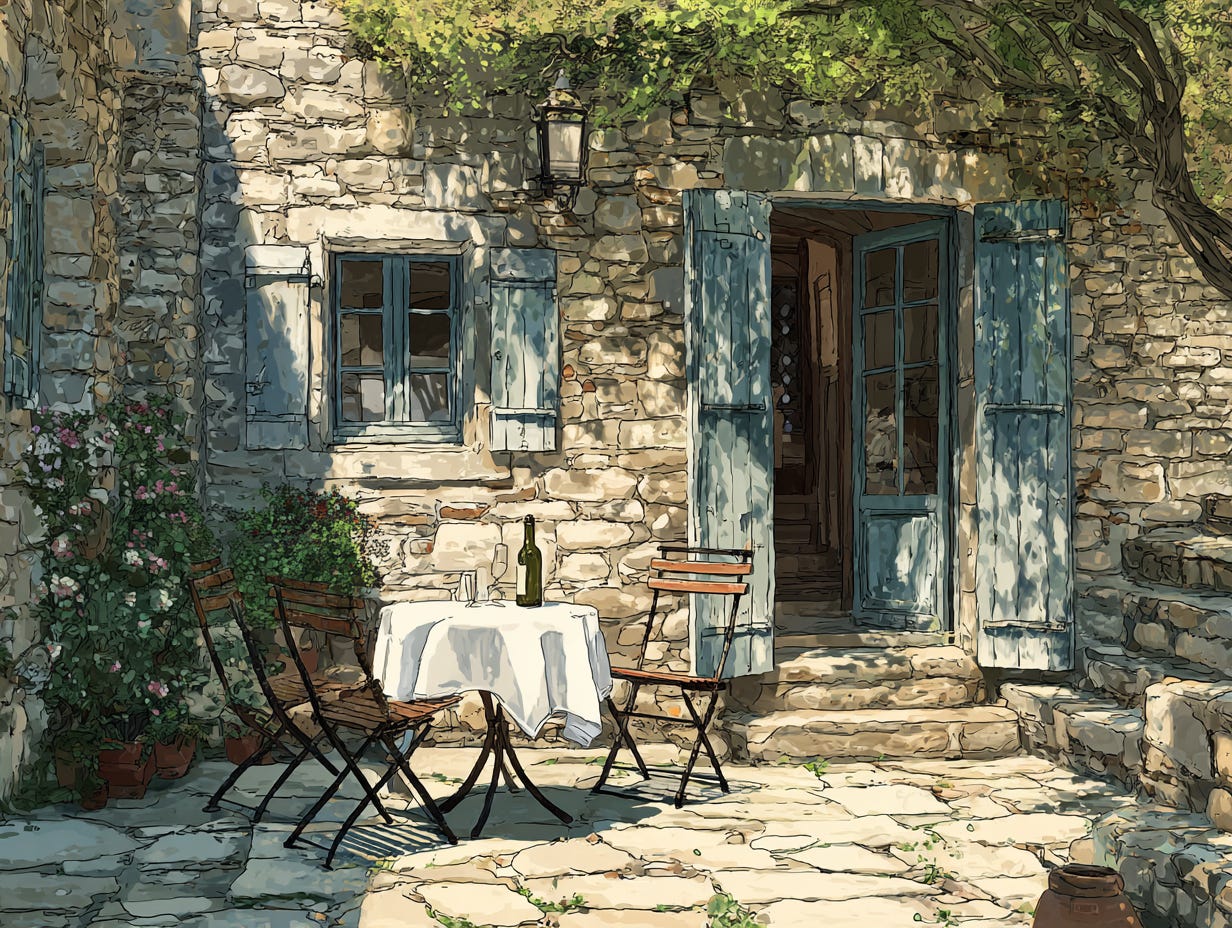
Americans love to believe the French have some secret formula for beauty. The perfect undone bun. The smudgy eyeliner that somehow looks intentional. The shutters painted in “just the right shade” of faded sage green.
We copy it. We bottle it. We even sell it back to ourselves as lifestyle products.
“Shabby chic” furniture. “French girl” makeup routines. Instagram corners styled to look like they’ve been left alone for a century.
The thing is, in France, it really was effortless.
The beauty of what’s left unfinished.
French aesthetic, as far as I can tell, is mostly the result of not getting around to things.
Those faded shutters? They were repainted fifteen years ago and haven’t been touched since, because the owners were too busy napping, cooking, or dealing with French admin.
That dreamy ivy climbing the wall? It’s there because no one had time to trim it back.
The romantic greenhouse with a few missing panes of glass? Nobody planned that. The glass just broke and stayed broken.
The French version of “effortless chic” is often just…lack of maintenance. And yet, paradoxically, it’s gorgeous.
A history of grandeur, a reality of shrinkage.
Many of the properties that define “French style” today were once staffed by entire teams: gardeners, butlers, maids, cooks. Maintaining a large château or large manor house was never meant to be a one-family gig.
Fast forward to the 21st century: families inherit sprawling estates with stone walls, tiled floors, and gardens the size of three football fields…but without the army of hands to keep it pristine.
What’s left is this beautiful in-between - a place that looks exactly like what it is: old, imperfect, and thoroughly inhabited. Somehow that's the most beautiful version of it.
Of course, this doesn’t apply to every French household. Plenty of people here gravitate toward modern, minimalist styles - sometimes as a deliberate rebellion against the burden of old things. If your family spent decades patching ancient shutters or paying through the nose to repair a leaking roof, you might crave clean lines, easy upkeep, and furniture that doesn’t collapse if you sneeze near it. The effortless aesthetic I've fallen for is one thread in a much larger tapestry. France contains multitudes, including plenty of people who want nothing to do with faded shutters and climbing ivy.
If you're new here, I'm an American writer living in a small château in rural France with my husband and two children. Once Upon a Castle is where I write about the château, the renovation, and the ongoing education of two Americans in rural France who thought they knew what they were getting into. What you're reading is free. Paid subscribers get four additional posts each month - two more essays about French culture and life from the inside, and two renovation diary entries documenting the detailed renovation, in real time. Come stay a while.
The makeup parallel.
It’s the same story with French beauty. Americans obsess over “the French girl look” - a dab of lipstick, no foundation, perfectly mussed hair. Entire industries have been built on teaching us how to look like we didn’t try.
But in France? They really didn’t try.
They were too busy at the market. Too busy cooking lunch. Too busy living.
And yet, it’s not sloppy. It’s not pajamas in Walmart or yoga pants at Trader Joe’s. There’s still pride in presentation. An unspoken standard of showing up well.
French women aren’t spending hours layering products or curling every strand. They pull something together quickly, but with just enough care to look lovely, polished, and put-together. It’s the difference between effortlessness and neglect. And that fine line - that balance of not fussing but still caring - is what makes it all look so…pretty.
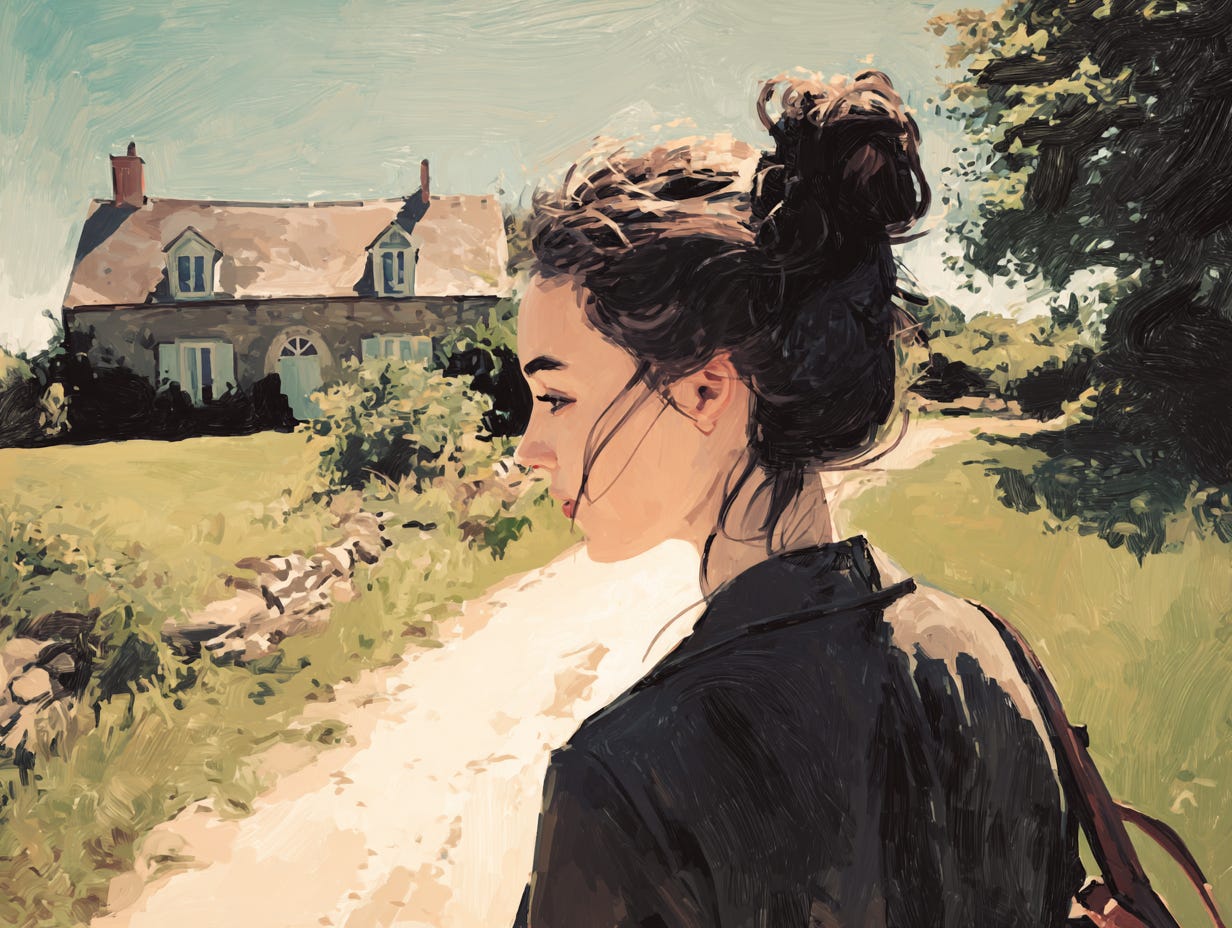
The American reflex (and my own).
Americans aren't doing it wrong. We're doing it the way we were taught, which is to fix and optimize things (coming from a culture that prizes polish, productivity, and control). From the moment we’re old enough to decorate our dorm rooms, we’re taught to “finish” things - repaint the furniture, keep up the yard, patch the cracks, reapply the mascara. And I was absolutely swept up in it, too.
When I lived in California, I too tried to curate the effortless look - searching for shabby chic finds at flea markets, attempting messy bun tutorials on Instagram that, ironically, took me twice as long as just doing a normal bun.
What I've realized living here is that nobody chose any of this. It accumulated. The garden looks romantic because we don’t always have time to cut it back. The kitchen resembles a French country painting not because of careful styling, but because bay leaves actually are hanging from twine to dry, and apples end up scattered across the old table simply because there’s nowhere else to put them. Makeup goes unworn not because I’ve mastered some minimalist routine, but because there are kids to get to school, meals to cook, work to do, and sometimes - imagine this - rest to be had.
And that’s the irony: what gets carefully staged in America with Pinterest boards and products is, here, the natural byproduct of life itself.
Why it works.
The secret isn’t that the French have some magical eye for beauty. It’s that they live in a culture where imperfection isn’t instantly fixed, where old is allowed to stay old, and where being a little undone isn’t seen as failure.
There's no strategy here. No aesthetic vision board. Just a life being lived in a place, leaving its marks.
That's probably why it looks so good from the outside. We've been trying so hard to achieve it that we've forgotten it was never supposed to be achieved.
The Bottom Line.
The French aesthetic asks very little of you. Mostly, it asks you to leave things alone.
Less repainting. Less perfecting. Less optimizing.
The shutters will fade. The ivy will climb. The eyeliner will smudge. Which is, as it turns out, exactly where the real beauty comes in.
(We’ll see how long I can actually last without repainting the shutters - but for now, I’m choosing to call it “romantic patina.”)
À bientôt,
Kamille
Once Upon a Castle is where I write about this life - the château, the renovation, and what it actually looks like to trade everything familiar for something completely unknown. Free subscribers get two posts a month. Paid subscribers get six - two more essays like this one, two renovation diary entries from inside the walls, and access to everything in the archive.
I'll now make a gross generalisation....🤫
Most French people, many of whom have grown up in apartments, want a house that is essentially an apartment with its own roof, easy to maintain, heat and keep clean.
Other nationalities (including me)buy houses that the average French family would not look at. Rural transport is very much car dependent, and if you're having to travel down picturesque country lanes, with their equally picturesque tractors and manure-sprayers, an hour's drive to work can quickly become two.
So they buy one of Pete Seeger's "little boxes" on a "lotissement" estate where they can get a bus to work. It's not romantic or shabby-chic, but it's a pragmatic choice. They are very happy, though, and grateful too, that nice Americans and others come and take care of the older houses, and why not?
Love this. So many Americans romanticize European lifestyle choices without understanding that the underlying “want” and “push” is actually what keeps them from having it.