


If you're new here: we're an American family living in rural France, restoring a small château, and writing it all down. Castle Diaries is the paid subscriber thread where I share the renovation in real time.
When we bought the château, we were told, politely, officially, on paper, that the septic system was non-conforme. That meant we had one year from moving in to replace it.
We were also told, off the record, with a small smile and a bit of a shrug, that “no one will really come check.” Wink wink. France is full of these moments. The official rule is one thing. The unofficial understanding is another. The two coexist peacefully, the way two cats coexist when neither wants to acknowledge the other is in the room.
A friend of ours, a fellow château owner, came over for lunch shortly after we moved in. We mentioned the septic situation. She tilted her head and said, “Does it work?“
Yes, we said. It works.
“Then why replace it?” she said. “Wait until it breaks.”
This is excellent advice, financially speaking. It is also the advice that everyone in our part of France has apparently been giving each other for several decades, which is how you end up with a region full of buildings whose septic systems are roughly the same age as the buildings themselves, all very much non-conforme, all working fine for now, all being sold from one owner to the next with the same small smile and the same shrug.
We were on board with this plan. We were going to wait until it broke. We were going to be sensible.
Then it began acting up. Loudly. Persistently. In ways that turned out to be much weirder than we’d been warned.
That part of the story deserves its own post, and it will get one. But dealing with it forced us to confront something we’d been somewhat ignoring: the coach house has its own septic system. A separate one. Also non-conforme. And unlike the château, the coach house has a deadline that cannot be ‘shrugged’ at.
The Deadline
We are opening the coach house for short-term rentals this summer. This is the first piece of the property to come online as a working gîte, and the timeline is real and tight. Everything that has to happen before guests can sleep here has to happen very soon, and the first thing on that list, the thing nothing else can move forward without, is a septic system.
The coach house has been sitting here for a few centuries without one. Or so we assumed.
When the team arrived to install the new system, the first question they asked was: where is the existing one?
We did not know. The previous owners had not known. The papers from the sale did not say. (Are we sensing a pattern?) They started digging in the general area we all agreed seemed most likely, and eventually unearthed it: a very old, very small tank that someone had installed at some point and then, as far as we could tell, never mentioned to anyone again.
Then they started the actual installation. And that is where the trouble started.
The Walnut Tree Situation
Before the digger could begin its real work, there was a problem in the way. The problem was a walnut tree.
It was not a thriving walnut tree. It had been planted at some point in a spot with too much shade, by someone who either didn’t know or didn’t care that walnut trees prefer sun. It had grown sideways trying to find some, leaning at an angle that made you tilt your head when you looked at it, the way a dog tilts its head when it hears the word ‘treat.’ And it was sitting exactly where the pipes needed to go.
I had assumed this meant the tree was going to die. Sometimes things have to die for septic systems. This is the order of the world.
But the man operating the digger looked at the tree, then looked at us, and offered, quite casually, to replant it. Apparently this is the order of France. We walked the property together looking for a better spot, and he pointed to a place I would never have chosen on my own, in the orchard area, full sun, plenty of room, no other trees competing for the same light. Then he dug it up, carried it over, planted it, staked it with reinforcements to hold it straight, and patted the soil down with the care of someone whose grandmother was watching.
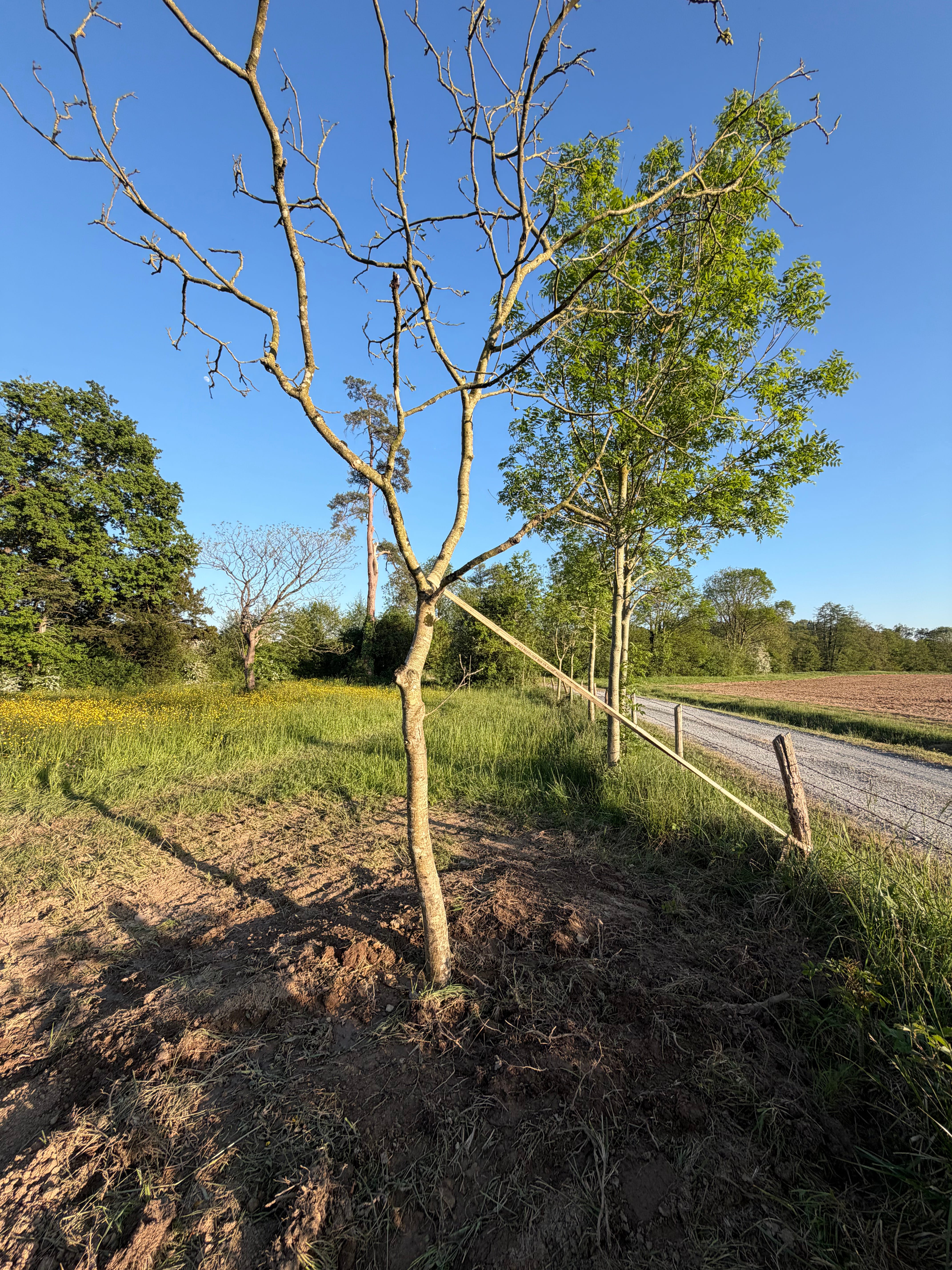
The tree is now standing upright. In the sun. Vertical for perhaps the first time in its life. It is much happier now (and so am I).
I have lived in places where if a tree was in the way of a pipe, the tree’s last day was today. The tree’s last day, here, became the first day of a much better life.
The Permission Cascade
The next problem was the road.
Our property is up a small road, and across that road is one neighbor’s house. To get the septic line where it needed to go, the pipes had to run under the road. The road, it turns out, does not belong to the commune. It belongs to a woman who lives up the hill, and she had to sign a document giving us permission to dig under her road.
We asked. She signed. Everyone was very pleasant about it.
We thought we were done.
Then we found out that the specific five centimeters of the road we needed to dig under did not belong to her. It belonged to the neighbor across the way, because at some point a property line had been drawn that put approximately the width of a smartphone of road into his lot. So we needed his permission too. For five centimeters.
He also signed. He was also very pleasant. France is full of moments like this, where something that would be a nightmare in the States becomes a small piece of paperwork and a friendly exchange, and you walk away thinking that was much easier than it had any right to be, and also I cannot believe we just got permission to dig under five centimeters of someone’s gravel.
Pas Esthétique
Then came the vent.
Septic systems need to vent. I now know this. I did not know this last month. The vent is a pipe that goes up, releasing whatever needs to be released into the sky, and the question becomes: where on the building does the pipe go?
The team wanted to run it straight up the main wall of the coach house. A tall, fat, very visible and very ugly pipe, climbing the side of a beautiful stone building like ivy if ivy had no aesthetic interests whatsoever.
I said no. Specifically, I said "pas esthétique," which translates roughly to "over my dead body, but politely."
This kicked off an hour of standing around pointing at different walls. Every alternative had a problem. That one’s not high enough. That one’s too close to the window. That one is the wrong side of the building. I started to feel like the unreasonable one, which I was, by the standards of septic installation. By the standards of a 17th-century coach house, I was exactly correct.
We finally found it: a spot tucked next to an existing pipe on the side of the old fournil, the little bread-oven house that sits behind the coach house. Out of sight from anywhere a guest would look. Aesthetically (mostly) invisible. Functionally fine.
The team said yes, this would work, but it required a roofer to come in and route the pipe under the roof tiles before placing the vent. We did not have a roofer available. We had not been able to get a roofer on the phone for months.
I assumed this meant we were back to the giant wall pipe.
The rest of this post is for paid subscribers. You'll get: the small miracle that happened that afternoon, the trench-of-opportunity moment where I had a surprisingly useful idea, Sean's contribution (which is very Sean), and the before-and-after photos of what our beautiful green courtyard looks like now that it is a mud field. Plus a preview of what's coming next, including the much bigger septic story unfolding at the château itself.
