


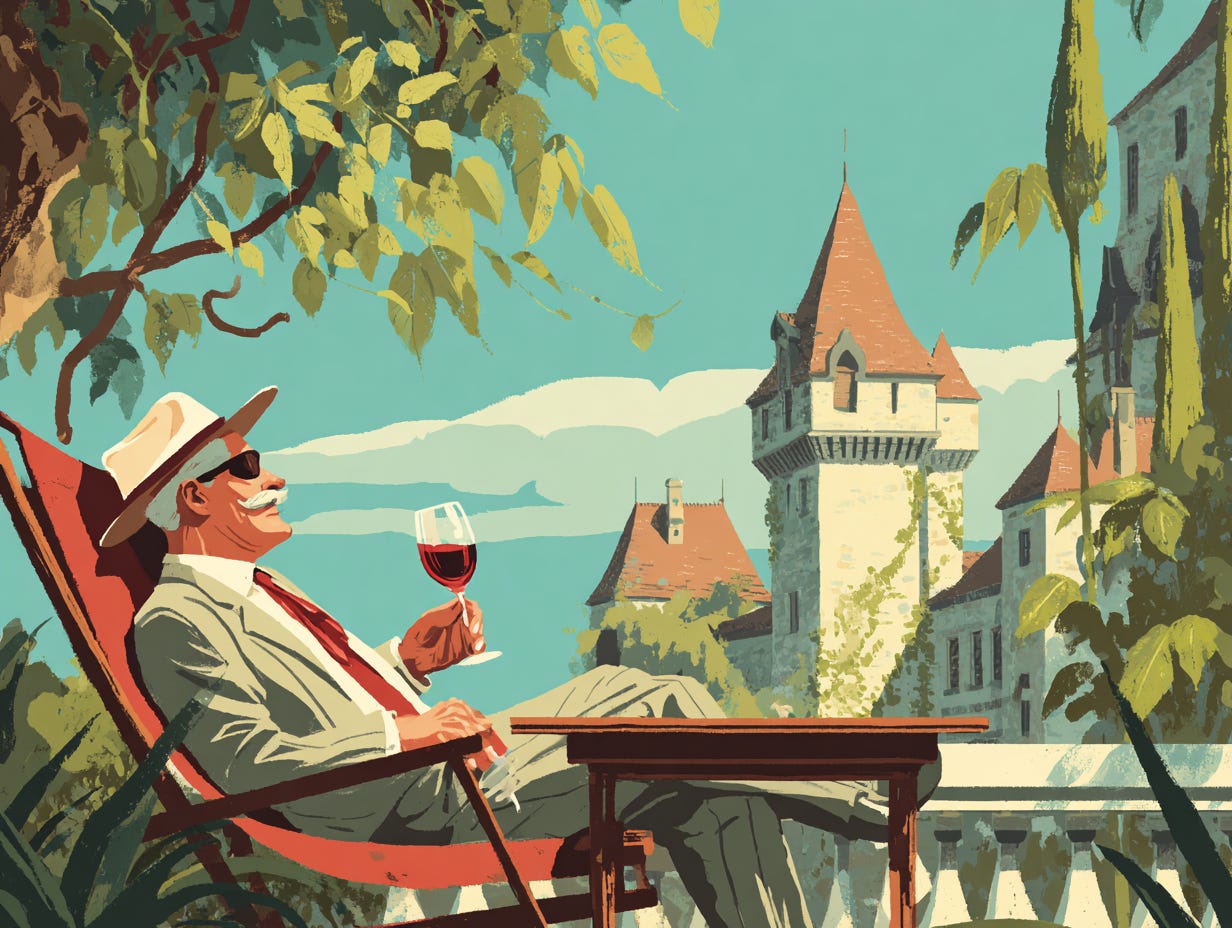
When we first moved to France, I thought everyone had collectively given up.
Shops closed at random hours. Restaurants turned us away at 2:15 p.m. with unapologetic shrugs. Entire towns seemed to go on sabbatical every August. And I remember thinking: How does this country even function?
In California, I could get Thai food at midnight, have Amazon drop off a toothbrush by sunrise, and reach a customer service rep even during lunch. In France, everything comes to a gentle halt. If you call a dentist’s office at 12:02 p.m., you’ll be met with a voicemail that might as well say, “Non.” The midday break isn’t just a pause - it’s a protected ritual. Lunch is not something to be rushed, skipped, or eaten over your keyboard.
It’s sacred.
The Great Culture Shock of “Closed”
When we first arrived, I had to unlearn decades of American convenience.
In the U.S., I never checked opening hours, because why would I? Stores were open when you needed them. Restaurants stayed open late for customers. Someone, somewhere, was always hustling.
But in France?
If you try to find lunch at 2:30 p.m., you are officially out of luck.
If you plan errands on a Monday, that’s cute, but no.
If you forget to check whether the boulangerie is fermé pour congés (closed for vacation), prepare to go breadless for a week.
At first, I was furious. I’d stand in front of locked doors thinking, Don’t you want my money?
And the answer was, not that much.
The Dishwasher Debacle (A Masterclass in French Indifference)
My favorite example: the dishwasher.
When ours suddenly broke - mid-school week, mid-lunch dishes, mid-life - I emailed a local repair company first thing in the morning, practically begging for a same-day appointment.
They replied after lunch (of course) to say they couldn’t come that day or the next.
So I wrote back immediately - any day that week or next week?
The next morning, I received a perfectly polite, two-word reply:
“Malheureusement, non.” (“Regrettably, no.”)
That was it. No explanation. No alternative. No eager effort to win my business or capitalize on my desperation for swiftly cleaned spoons.
And it wasn’t personal - it was cultural.
The French simply do not hustle.
They do good work, but on their schedule. They take rest seriously. They do not chase urgency. And they have absolutely no interest in your customer-service anxiety spiral - which, if you can stop hyperventilating long enough, is frankly kind of admirable.
The Lunchtime Doctrine
In America, lunch is something you eat while doing something else - answering emails, driving, talking, planning. In France, lunch is the something else.
If you call anyone between 12:00 and 1:30 p.m., they are not answering. Not the post office, not the plumber, not even the mortgage broker. If you ask them to handle a “quick” task before lunch, they will smile and say, “Non, après déjeuner.”
And they mean it. Even if your “quick task” would take thirty seconds.
At first, I saw it as laziness.
Now, I see it as a form of national self-respect.
They don’t let urgency dictate their humanity. They eat, rest, and talk, without guilt. (And they do it with wine.)
The Economics of “Enough”
Here’s what I’ve realized:
The French don’t care less - they just care differently.
Work is a part of life, not the purpose of it. They value competence, but not obsession. They’d rather do one thing well than juggle three things frantically.
And when business slows, they don’t panic. They pause. They sip. Maybe they take Friday off. They trust that life moves in seasons - and not all of them are for sprinting.
It’s not laziness, but rather, perspective.
France may have slower service and shorter hours, but it also frequently enjoys higher-than-average life expectancy and strong labor productivity relative to its working hours.† They tend to rest hard so they can work well.
And it’s not just the adults who benefit. As I shared in this essay about France having the third-happiest children in the world, this cultural rhythm of slowness, presence, and enough is passed on generationally. The message is clear: your worth isn’t tied to constant output. Joy, rest, and family time matter, and they’re protected.
Meanwhile, many Americans - myself included - have been conditioned to equate exhaustion with virtue. We rush, optimize, and measure self-worth in output. We’ve built an entire culture on “How much can I fit into one day?” while the French are over here asking, “Why would I want to?”
Learning the Art of Slowness
Two years in, I’ve adapted.
When we’re out, we eat lunch at 12:30 p.m., because that’s what you do.
We avoid errands on Mondays.
We check opening hours religiously.
And you know what?
It’s better.
City centers are calmer. Families eat together. People walk more. No one feels rushed. You plan ahead, but you also slow down.
It’s not inefficiency. It’s intentionality.
The Bottom Line
The French aren’t lazy - they’re just not chronically exhausted.
They’ve built a culture that values enough over excess, rhythm over rush, and rest over whatever it is we’re all frantically chasing by 9 a.m.
And maybe, just maybe, they’re not out of step with the world.
Maybe they’re simply walking at a pace we’ve forgotten how to keep.
À bientôt,
Kamille
A note for new readers: we’re an American family living in rural France, restoring a small château, and writing it all down here.
Paid subscribers get Castle Diaries: the chateau renovation journal, written in real time.
† Notes & sources
In the OECD’s Health at a Glance data, France’s life expectancy is about 82.4 years, which is roughly two years above the OECD average.
According to TheGlobalEconomy.com (drawing on OECD data), France’s GDP per hour worked is indexed at ~94.81 relative to the U.S. (= 100) as of 2022 - meaning French workers remain quite productive, even if not uniformly “more productive.”
The OECD defines “GDP per hour worked” as a standard metric of labor productivity (i.e., output per hour) across countries.